Producing as Pollination (Actus Reus)
Updated: May 12

There is a particular kind of generative work that doesn't always announce itself, and in many ways it is in direct contrast to performance. It happens in the margins of the calendar, in the emails sent at odd hours, in the budget lines you review because your standards demand it. It happens also when you show consideration, attend birthdays and collaborators' concerts, bear literal and figurative gifts; flowers versus feeding the lines of the first drafts of Letters of Support. There is, after all, a relationship between getting to know the people and Knowing Your Rights.
That is what it means to produce: to bear gifts, offer knowledge and hold space. Exceptional producers do all this from a space of both inspiration and integrity.
For the past year, I was Executive Producer of Actus Reus, a MAPFund-supported experimental theater work that premiered Off-Broadway this spring. The 75 minute show ran fully sold-out across all three of its performances: a preview on April 16th at Berried Seed, and two closing nights on April 23rd and 24th at The Atrium in Ridgewood, NYC. The $30,000 grant that made it possible was awarded by the MAPFund, which invests in performing artists whose work imagines a more equitable, blossoming society.
I think Actus Reus earned that investment. The show was defined by remarkable performances, inventive choreography, an original script, a dedicated director, new music, a custom marketing campaign, a meticulous stage manager, distinctive venues, and collaborators who believed in the work. See the program PDF by downloading it:
The project was led by Grant Custodian and Core Artist Emé Esquivel, and anchored by Lead Actress and Core Artist Soft Abilez, both of whom I had worked with previously in different capacities. Soft appeared in Jaguars in Jumpsuits, an international film project I wrote and directed in 2020. I first discovered her at Gallery Petite, at an Open Mic I had produced in Bushwick. Emé was the Core Artist of HERIDA (2023), another work I directed in Manhattan. HERIDA remains a cornerstone of his artistic practice.
I originally met Emé at a house party in the orbit of La MaMa Etc. At the time I was associate producing the iconic choreographer and performance artist Yoshiko Chuma's Love Story. He was crashing on her couch, as she occasionally hosts select artists. I recognized his potential early and counseled him on grant applications. In 2022 I put him forward for a $500 micro-grant for theater artists with IndieSpace, one I had previously received myself. He was awarded it.
In both artists, I always recognized immense potential. Actus Reus was a reunion of sorts; an opportunity to support collaborators I believed in, from a new vantage point. I had not previously served in support roles to either of these two artists. Historically, I'd led them.
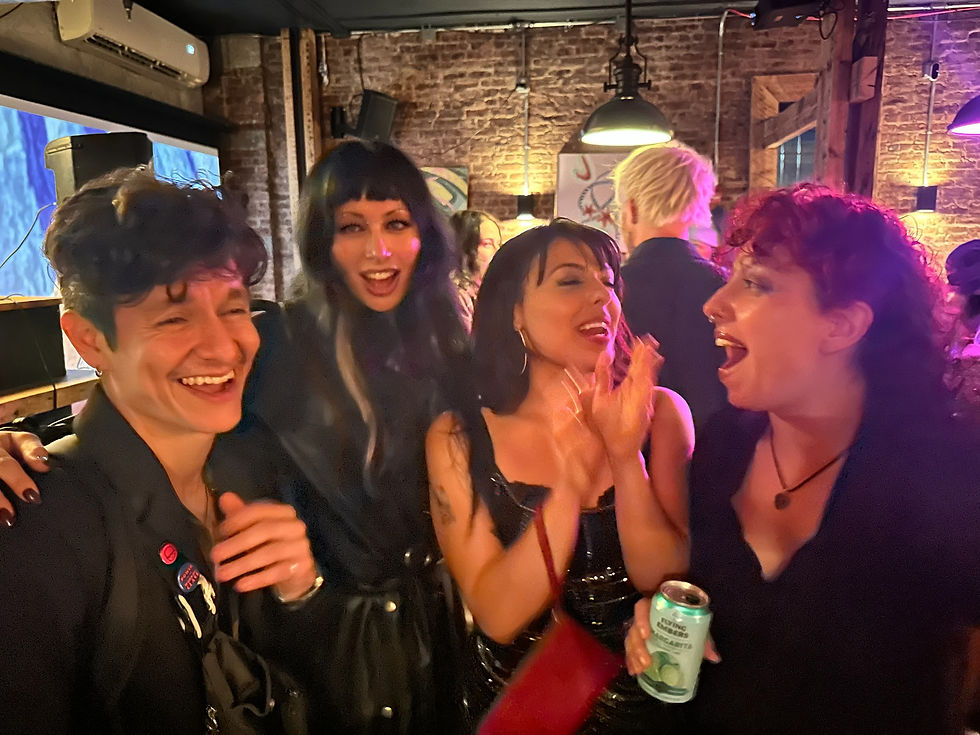
The work of producing is not new to me, but each project reveals something different about what the role demands. On Actus Reus, it required range: counseling on sensitive dramaturgical matters, budget oversight, contract management, staffing, marketing support, community outreach, archival documentation, relentless networking, and the kind of quiet diplomacy that keeps a show moving when the weight of it starts to show. I consistently raised the bar on deliverables, as the work demanded and my standards required. That is the nature of producing at the level I practice it.
The Actus Reus website refers to the team as "hungry," a metaphor that speaks to both artistic appetite and the material conditions that shape creative work in this city and this moment. Actus Reus' script itself is rooted in questions about labor, consumption, and what we owe each other: themes that feel urgent in 2026 in ways that are almost impossible to overstate.

The original grant proposal for Actus Reus was partly inspired by Itinerant, a short film project I had proposed to Soft and Emé several years prior — one that planted seeds without needing to bloom itself. In acknowledgement of my conceptual influence on Actus Reus and because I first brought the two together to talk shop — Soft approached me with the offer that I submit a proposal to work on Actus Reus with her and Emé. I subsequently reached out to Emé, who before I had even formally signed on, picked my brain and had me review his contract with MAPFund, the original proposal, and other materials. I was glad to, still quietly seeing Emé and Soft as amongst my coterie of New York based protégés, and as pals.
To be clear, I wasn't in New York when the proposal for Actus Reus was written. I was on Long Island, serving immigrant communities as an Arts Coordinator at CAST, doing essential and unsung work that rarely makes it into grant applications but shapes everything downstream. That my creative sensibility found its way into the DNA of Actus Reus anyway feels right. Work travels. Influence is rarely linear. But I also don't intend to overstate my influence; the project is rightfully Core credited to them.
After signing on as Executive Producer, I drew on my full range of expertise and networks. Among my contributions: acquiring a Letter of Support from MAPFund to bolster matching grant potential, gifting Emé a key role at my own show The Sacred and the Profane at Erf World and opening that platform to Actus Reus promotions, attending arts galas, producing events, contributing to early ideation sessions as the script was still being written, co-negotiating contracts, navigating team dynamics, hosting meetings and working sessions in my home.

Producing experimental theater in New York City in 2026 is an act of optimism that borders on defiance. The spaces are expensive. The timelines are compressed. The labor is immense and often invisible. Compensation rarely reflects the true value of what is contributed. On this particular show, I held the line on bonuses, proper credits, and transparency — for myself and for others. That is not always easy. I did it anyway, because integrity is non-negotiable.
What makes it worth doing — what made Actus Reus worth doing — is the moment the audience walks in, the show starts... and something shifts. All three nights, the house was full. That doesn't happen by accident. It's a result of careful planning, buy-in across the frontstage and backstage teams, and funding. It happens because of the teamwork of arts professionals working in a variety of capacities, often wearing multiple hats. Ultimately, because we love to make art.

My dear young friend and occasional collaborator Miles Westrich, a visual artist and photographer who served as an usher on two nights, disclosed to me after the show's run that the work had inspired him to return to the studio. More seeds are sown.
I'm glad.
Celestina Cardona Billington is an artist, producer, and arts administrator based in New York City. She is currently Executive Producer of Actus Reus, which was initially supported by a grant from the MAPFund. This iteration of the project ends August 1st, 2026.
Blog post edited with assistance.


Comments